

When you started your dental career, you built your practice on trust, skill, and word-of-mouth referrals. It felt simpler. In today’s digital world, however, the journey a patient takes to find your practice has evolved. They are online, searching for a “dentist near me” to decide where to schedule their next appointment. On top of that, search results have changed. Search engines like Google now provide AI-generated responses to give users quick, summarized answers. To understand how this impacts your ability to reach new patients, it’s important to understand what exactly “GEO” is.
Generative Engine Optimization “GEO” – Making Your Dental Practice AI-Friendly
You’ve heard of SEO (Search Engine Optimization), which is the way to get your website higher rankings in search results. Now, AI has entered the chat. Meet Generative Engine Optimization (GEO).
To keep it simple, GEO means setting up your website content so that AI tools (like Google’s AI Overview) can easily find it, understand it, and recommend your practice to people searching online. Think of it as making your website “AI-friendly.”
What Exactly Are AI-Generated Search Responses?
Think about a patient searching on Google for “what is a dental implant?” There are two ways search engines respond to that question:
- Traditional SEO (intent-based): Google will show a list of links for patients to click on and visit dental websites, blogs, or directories to find an answer for themselves.
- AI Overview or GEO (information-based): Now, Google often uses Artificial Intelligence (AI) to give a direct answer or a quick summary at the top of the search results. AI might pull information from several websites to give the user what they need immediately, before they even see the list of website links. See an example of this below.
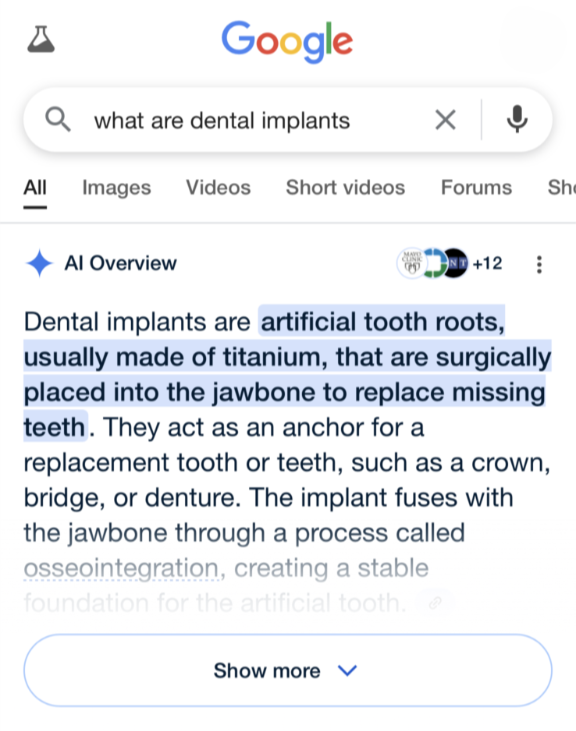
Rest assured, SEO isn’t going away. While AI often handles informational searches (like “what is teeth whitening?”), traditional SEO remains crucial for intent-based searches when patients are actively looking to book an appointment or find a dentist near them. The goal should be for your practice to show up in both types of searches.
How Does GEO Impact Your Dental Practice?
- AI directly answers specific patient questions, so having clear content on your website is crucial for visibility.
- AI’s direct answers may reduce clicks, but if it names your practice as a source, your reputation will grow.
- AI prioritizes helpful, detailed website content that answers patient questions, not basic pages.
- For “near me” patient searches, ensure your Google Business Profile is always accurate and updated.
- Your practice’s five-star online reviews are even more essential as AI considers them for recommendations.
Actionable Steps: How Can Your Dental Practice Can Adapt?
Even without a marketing team, you can take the following simple steps to get ahead:
1. Think Like Your Patients (and AI):
- Answer common patient questions on your website clearly and simply.
- Make separate pages for each main service you offer (e.g., “What to Expect with Dental Implants,” “Sedation Options for Nervous Patients”). An FAQ page is also great.
- Use natural, conversational language, as if you’re explaining something to a patient in your office.
2. Keep Up with the Locals:
- Make sure your Google listing is 100% correct, complete, and up to date. Ask patients for reviews there.
- Include your town or area in your website text.
- High-quality, mobile-friendly websites make it easy for search engines (and AI) to trust your practice.
3. Focus on Being Helpful:
- If your blog about “How long teeth whitening lasts” helps the reader learn something, AI is more likely to use it.
- Look at your older website pages and blogs. Can they be updated with the latest information?
4. Actively Manage Your Online Reviews:
- Ask for Reviews. Make it easy for happy patients to leave a review, especially on Google.
- Reply to Reviews. Thank your patients for giving positive reviews and respond professionally to any concerns.
The Future is Now: Don’t Get Left Behind
AI in search isn’t just coming; it’s already here and changing fast. This might seem like another new thing to learn, but it’s also a chance for your dental practice to shine.
By creating helpful, patient-focused content and taking these simple steps, you can help your practice stay visible and competitive on the web. You don’t need to be an AI whiz – just focus on being the helpful, trustworthy dentist you already are, and make sure your website shows it.


