
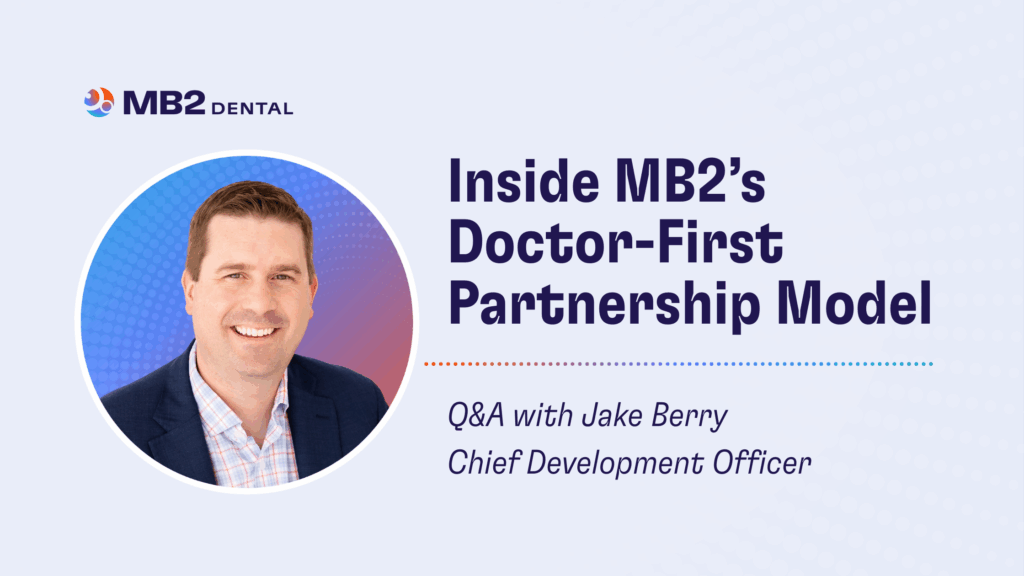
If you’re a private practice dentist thinking about your future—whether it’s selling to a DSO or partnering with a dental group—it helps to hear directly from the people behind the scenes.
Jake Berry, Chief Development Officer at MB2 Dental, has spent the last eight years helping MB2 become one of the fastest-growing Dental Partnership Organizations in the country. Before MB2, Jake served as a Marine and worked in investment banking—experience that shaped his leadership style and strategic approach to building doctor partnerships that last.
We sat down with Jake to get his perspective on MB2’s growth, the changing DSO landscape, and what doctors should consider before making one of the biggest decisions of their career.
Q: You’ve had an interesting career path—how did you end up in the dental industry?
Jake: It wasn’t exactly a straight line. I studied financial economics in college and joined the Marine Corps right after graduation. I spent 10 years serving, with multiple deployments, then transitioned into investment banking. That’s where I learned the fundamentals of dealmaking and business growth—which eventually led me to MB2.
Q: How have MB2’s doctor partnership initiatives changed since the time you joined MB2?
Jake: In 2017, it was just Dr. V and me running Business Development. We were doing everything—meeting with doctors, negotiating deals, running numbers. As the velocity of M&A volume increased, we had to quickly scale a team to be able to engage with more prospective partners.
Fast forward to today, we have closed over 550 transactions across all specialties and most of the country. We have learned so many lessons as to what works, and what does not. We’re constantly refining our processes to make sure that all lessons learned help us have more successful partnerships and deliver more day-to-day value to our doctor partners.
Q: From your perspective, how has the DSO space changed over the last few years?
Jake: The DSO landscape has changed a lot. The DSO market grew very quickly, and for many groups, rapid inorganic growth was prioritized over long-term stability. Now that the operational, investor, and financing environments have all changed, we are seeing the fallout of that behavior. Our market is oversaturated, and most DSOs do not have a long enough track record established yet to show institutional investors that they can sustainably grow and operate their portfolios. Additionally, there is a myriad of equity models for doctors and a large number of DSOs that are focused on specific specialties and geographies.
That’s why it’s important for practice owners to take the time to determine what they want to accomplish in a DSO transaction and if the DSO they are selling to, or partnering with, has the track record, infrastructure, and financial standing to help them achieve their financial, professional, and personal goals.
Q: When meeting with a DSO, what things should a doctor consider?
Jake: If the conversation is only about the multiple—and there’s no discussion about transaction structure and what happens on a day-to-day basis after close—that should force a doctor to reevaluate their own motivations and the long-term viability of the DSO. Be cautious of buyers that present an overly aggressive practice valuation or overly cash-heavy deal, and make promises of pie-in-the-sky returns through future private equity transactions. Practice owners should be focused on their post-sale income needs in addition to the transaction outcome, how their practice and their team will be integrated into the DSO, and how their lives will be made better post-sale.
Q: What makes MB2’s Dental Partnership Organization, or DPO, different from the traditional DSO?
Jake: A lot of DSOs were built by institutional investors with the intention of achieving rapid growth followed by a quick exit (i.e. sale to the next investor). That’s never been MB2’s approach. Dr. V’s vision has always been about creating partnerships with doctors who are committed to the long-term growth and success of their own practices.
We have a joint venture model, so instead of selling 100% of the practice, our partners only sell a portion and keep significant equity ownership. That structure enables MB2 to invest alongside our partners in their individual practices, help them improve their practices, and share in the future upside together. This model enables doctors to maintain clinical autonomy and leverage our infrastructure and resources to improve their business performance. Doctors do not have to make a trade-off decision in achieving liquidity of their equity value and surrendering control of the decisions that matter most in their practice.
Q: Can you share some examples of how the dental partnership model has impacted doctors?
Jake: I’ve seen doctors go from working five days a week to taking real vacations for the first time in years—without losing profitability. Others have been able to open additional locations because they have MB2’s systems, capital, and support. For older doctors, our model has enabled larger practice owners to maximize their equity value but also create a succession plan for their younger associates to take over some practice equity. More practically, we consistently improve practice profitability so that practice owners are able to grow their personal income through our partnership.
The common theme is that they still feel like they are empowered as practice owners (just with a lot less stress). They’re not “working for” a corporate group; they’re building their future with a partner who’s invested in their success.
Q: For a doctor who’s starting to think about selling or partnering, what’s the first step?
Jake: First, figure out your “why.” Are you looking for growth? Want to take some risk off the table? Hoping to get more personal time back? Trying to take your practice to the next level without giving up ownership? Without knowing that, it’s hard to find the right fit.
Second, get your practice ready. Know where your financials are—tax returns, leases, P&Ls, practice management reports. Deals can stall quickly if sellers don’t have that information organized and accessible.
Q: What about the doctor who’s curious but not ready to commit—what’s your advice?
Jake: It’s doesn’t hurt to start the conversation. You’re not committing to anything by asking questions. Learn how different models work, talk to doctors who’ve been through it, and look beyond the valuation. Most importantly engage in some soul-searching to decide how much longer you want to remain a practice owner. Developing your succession, or exit plan early is critical to helping you think about when to start executing on a practice sale.
This is one of the biggest decisions you’ll ever make. It will impact you, your family, team, patients, and legacy —so choose a partner that aligns with your goals, values, and vision for your future.
Want to hear more for Jake Berry?
Tune in to his episode on the MB2 Underground podcast where he shares additional perspective for dentists considering partnerships with a DSO, what makes our DPO model unique, and stories from his early days at MB2. Click below to listen now!
Ep. 24 | “EBITDAs & Such” | Jake Berry, Chief Development Officer
If you’re weighing your options, MB2’s team is always ready to connect you with a doctor partner who can share their firsthand experience. Fill out the form below to start the conversation.


